
Industrial Epoxy Flooring in Arizona for Plants & Factories
Epoxy, urethane cement and ESD floor systems for Arizona factories and plants — built for forklifts, chemical spills and thermal shock, with fast, phased turnaround. ROC #168150, since 1995.
★★★★★ 4.7/5 from 89 Google reviews|Licensed ROC #168150|Typically a 2-Day Install · Family-Owned Since 1995
 ★ 4.7 · 89 reviews
When a production floor fails, it takes uptime, safety and your maintenance budget down with it. Forklift wheels chew through thin coatings, a single acid drum tips and etches bare concrete, and a hot washdown line lifts an under-specced epoxy off the slab. In Arizona those failure modes get worse: triple-digit surface temperatures, wide day-to-night thermal swings, and slab moisture that pushes efflorescence and delamination up through floors that were never tested for it.
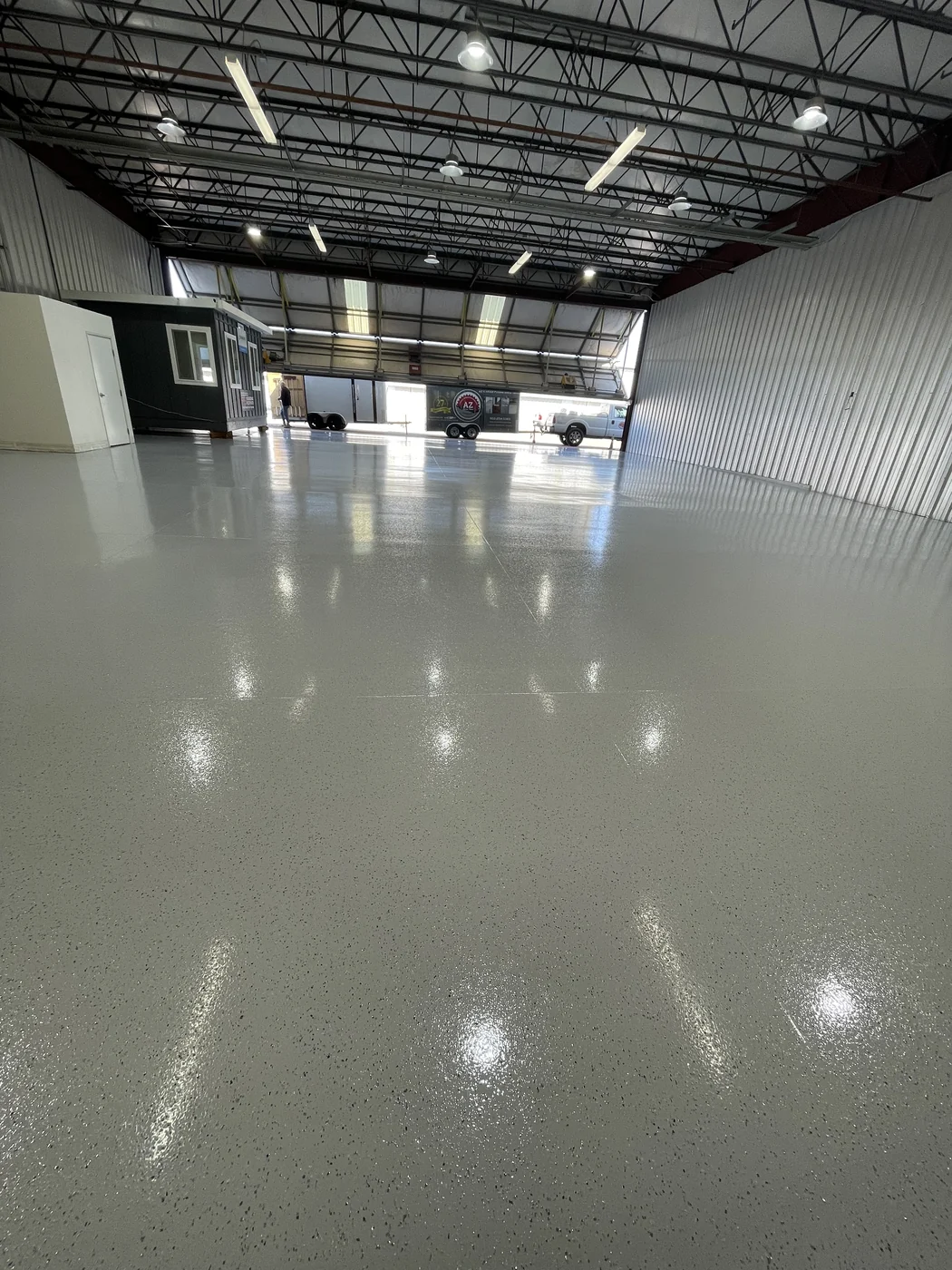
AZ Garage Floors is a licensed Arizona contractor (ROC #168150) that has coated industrial and manufacturing floors since 1995. We don’t sell one product and force-fit it — we walk your plant, test the slab, map your real exposures, and spec the system that will actually survive your operation. From high-build epoxy and epoxy mortar to urethane cement and ESD static-control floors, every install is engineered for heavy loads, chemicals and Arizona heat — and phased to keep your line running.
Industrial & Manufacturing Floor Coatings Built for Arizona Plants
A manufacturing floor is a structural asset, not a finish. It has to carry your traffic and your liability — OSHA slip ratings, USDA/FDA cleanability, ESD limits in electronics areas — while shrugging off everything your process throws at it. We build floors to that standard for plant managers, facility and maintenance directors, EHS officers and the general contractors who bring us into new-construction and tenant-improvement projects across the state.
As a family-owned Arizona company with a 4.7★ rating from 89 Google reviews, we work statewide — from our Buckeye, AZ home base out across the Phoenix metro, Tucson, and the manufacturing corridors in between. You get one licensed crew, a written system spec tied to your exposures, a limited lifetime residential / 2-year commercial warranty, and a free on-site walk-through before anyone quotes a number.
Arizona’s advanced-manufacturing boom is the backdrop for all of it: TSMC’s North Phoenix fabs, Intel’s Chandler/Ocotillo campus, and aerospace and defense work at Honeywell and Boeing in Mesa are pulling new factories, fab shops and processing plants online — all of them needing ESD, chemical-resistant and cleanroom-adjacent floors specced right the first time.
What Your Production Floor Is Up Against
Before we recommend a system, we catalog the abuse your slab actually sees. Spec for the worst-case exposure, not the average one, and the floor lasts. Here is what we engineer against in Arizona plants:
- Forklift & tow-motor traffic. Hard polyurethane wheels and constant turning shear thin coatings — mil thickness and the right topcoat decide whether a floor lasts two years or fifteen.
- Heavy point loads & impact. Racking legs, dies, pallet drops and rolling equipment concentrate tons onto small areas; we spec compressive strength and impact resistance to match.
- Chemical & acid spills. Solvents, caustics, hydraulic fluid and organic acids (citric, lactic, acetic) attack the wrong resin fast — chemistry has to be matched to your exposure list.
- Thermal shock & cycling. Steam cleaning, hot oil, freezer-to-dock transitions and Arizona’s daily temperature swing expand and contract the floor; mismatched coatings crack and debond.
- Dust & abrasion. Grit, metal fines and continuous wheeled traffic sand down soft finishes and raise housekeeping and air-quality problems.
- OSHA slip & safety. Wet processes and washdowns demand engineered anti-slip texture that still cleans easily.
- Desert heat & slab moisture. High surface temperatures, thermal swings and vapor drive from the slab are the quiet killers here — untested moisture is the single most common cause of coating failure we’re called to fix.
Our Industrial Flooring Systems
Different exposures call for different chemistry. Here is when we spec each system — and we’ll tell you straight which one your plant actually needs.
Epoxy vs. Urethane Cement: Choosing the Right System
This is the decision that makes or breaks an industrial floor, so we don’t hand-wave it. Both are excellent — for different jobs.
When epoxy wins
High-build epoxy and epoxy mortar are harder, more economical, and beautifully smooth. For dry-to-moderate manufacturing, assembly, machine shops and warehouse production — where the main abuse is traffic and the occasional spill — epoxy delivers the most floor per dollar and a finish that’s easy to clean and stripe.
When urethane cement wins
Urethane cement (urethane mortar) is thicker, more flexible and far more forgiving. It tolerates thermal shock and thermal cycling, handles slab moisture and vapor drive, and resists the organic acids and hot washdowns common in food & beverage. It’s the right call wherever steam, hot liquids, freezers or aggressive chemistry are in play — and it routinely lasts 20+ years.
The trade-off is cost and surface feel; urethane cement is a premium system. Often the best answer is a hybrid — urethane cement body with a polyaspartic topcoat for UV stability and fast return to service. We make that call with you after the walk-through, never before.
Engineered for Heavy Loads, Chemicals & Safety
Every spec we write is tuned to your numbers — not a generic data sheet.
Minimal Downtime: Our Phased, Fast-Cure Install Process
Production can’t stop, so we plan around it. We phase the work by zone and run off-shift, weekends or shutdown windows so you keep moving while we coat.
- 1. Walk-through & moisture testing. We map exposures, traffic and drains, then run calcium chloride / RH moisture tests before anything else — the result drives the spec.
- 2. Mechanical prep. Diamond grinding or shot-blasting opens the slab to a proper profile; we fill and repair joints, cracks and spalls. Prep is the single biggest factor in how long a floor lasts.
- 3. System build. Primer, body coat (epoxy, epoxy mortar or urethane cement), aggregate broadcast for slip, then the polyaspartic topcoat — built to your mil thickness.
- 4. Fast cure & return to service. Polyaspartic chemistry cures fast even in Arizona heat. A typical install runs about 2 days; you can walk on it the next day and return forklift and vehicle traffic in roughly 72 hours.
We never claim a one-day miracle — honest timelines and zoned scheduling are how plants stay in production through the install.
Industries & Facilities We Coat Across Arizona
If it runs heavy traffic, chemicals or strict cleanability standards, we’ve coated one.
Cost & Why Phoenix Plants Choose AZ Garage Floors
Industrial floor coatings in Arizona typically run about $5 to $12 per square foot installed. Where you land depends on mil thickness, slab condition and prep, moisture-mitigation needs, and add-ons like ESD, food-grade cove base or secondary containment. A urethane-cement food-processing floor sits at the top of that range; a high-build epoxy on a sound slab sits near the bottom. We give you a firm number after the on-site walk-through — never a guess over the phone.
Plants choose us because we engineer to the exposure instead of selling a product, we test moisture before we coat, and we schedule around your production. You get a licensed Arizona contractor (ROC #168150) with three decades of local slabs behind it, UV-stable polyaspartic built for desert heat, and a written warranty. Get a free on-site quote and we’ll spec the floor your operation actually needs.
Industrial Flooring FAQs
Ready to Spec a Floor Your Plant Can Count On?
Get a free on-site walk-through, moisture test and firm quote from a licensed Arizona contractor — engineered to your loads, chemicals and uptime.
or call (602) 254-3363
