
Warehouse Epoxy Flooring in Phoenix & Across Arizona
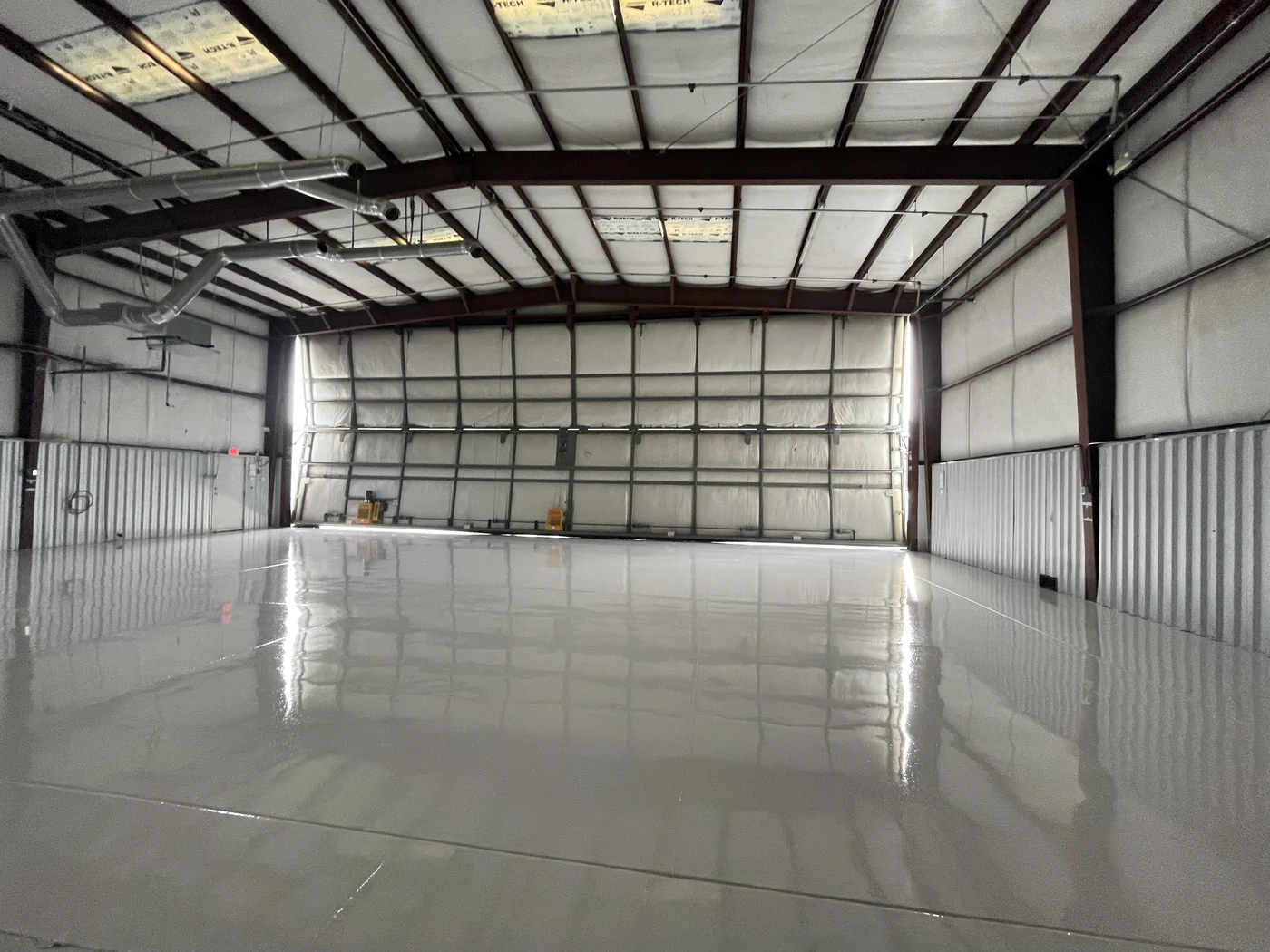
Forklift-rated epoxy, urethane cement & polyaspartic coatings for Arizona warehouses and distribution centers — installed in phases to keep you running. Licensed ROC #168150, family-owned since 1995.
★★★★★ 4.7/5 from 89 Google reviews|Licensed ROC #168150|Typically a 2-Day Install · Family-Owned Since 1995
 ★ 4.7 · 89 reviews
A bare or failing warehouse slab quietly costs you money every shift. Concrete dust coats inventory and racking, hairline cracks widen under pallet-jack wheels, and oil-darkened control joints spall until they catch a forklift tire. In a 5,000 to 200,000+ square-foot facility, those small problems multiply into safety incidents, OSHA exposure, slowed pick rates, and downtime you can’t afford.
AZ Garage Floors installs heavy-duty resinous floor systems built for real industrial traffic — high-build epoxy, urethane cement, and UV-stable polyaspartic. We’ve coated Arizona concrete since 1995, and we engineer every warehouse floor around three things desert facilities get wrong: slab moisture, thermal cycling, and the abuse that concentrates at joints and load points.
Family-owned and licensed under Arizona ROC #168150, we coat warehouses, distribution centers, and 3PL logistics floors across the Phoenix metro and statewide. We phase the work around your operations — nights, weekends, zone by zone — so the building keeps shipping while we install. Every project starts with a free on-site evaluation and a fixed, written quote.
Why Arizona Warehouses Need a Coated Floor
Arizona is uniquely hard on warehouse concrete. Most distribution floors here sit in un-air-conditioned buildings where summer slab temperatures swing dramatically between a cool morning and a 110° afternoon. That thermal cycling expands and contracts the slab daily, cracking brittle coatings and lifting the cheap one-coat paint many builders leave behind. Below the slab, desert ground moisture and caliche soils push water vapor up through the concrete year-round — the single biggest reason warehouse floors bubble and delaminate.
Bare concrete also never stops dusting. Every forklift pass and pallet-jack turn grinds fine cementitious powder off the surface, and in a distribution center that dust settles on product, racking, conveyors, and barcode scanners. It’s an air-quality and contamination problem that gets worse, not better, with traffic.
A properly engineered coating turns all of that liability into an asset:
- Dust control: seamless, non-porous resin locks the surface down and stops concrete dusting that contaminates product and clogs equipment.
- Safety & OSHA: anti-slip aggregate, bright light-reflectivity, and clear line striping reduce slip-and-trip claims and forklift incidents.
- Durability: high compressive strength shrugs off concentrated point loads from racking legs, mezzanine posts, and fully loaded pallets.
- Faster operations: a smooth, sealed floor lets pallet jacks and forklifts roll faster with less wheel wear and fewer jolts.
- Lower downtime cost: a sealed floor cleans in a fraction of the time and resists the oil, fluid, and chemical spills that otherwise shut zones down for remediation.
Add it up and the coating pays for itself. Less time spent sweeping and scrubbing, fewer slip claims and forklift mishaps, slower wear on equipment wheels, and a slab that doesn’t need patching every year all show up on the bottom line. The most expensive floor is the bare one you keep maintaining around — or the failed coating you have to tear out and replace mid-operation.
Our Warehouse Flooring Systems
We match the system to your traffic, environment, and chemical exposure — never a one-size coating.
Built for Forklift Traffic, Heavy Loads & Chemical Spills
Warehouse floors don’t fail in the open field — they fail at the joints, the edges, and the spots where loads concentrate. A coating that looks great on day one is worthless if it spalls at the first control joint or dents under a loaded racking leg. Our systems are spec’d for the specific abuse a working distribution center dishes out every single shift.
- Point loads & compressive strength: high-build epoxy and urethane cement carry concentrated racking and pallet loads without cracking or indenting.
- Abrasion resistance: hard-wearing resin stands up to steel pallet-jack wheels and constant forklift turning in pick aisles.
- Joint filling: we fill control and construction joints with rapid-set polyurea so forklift wheels roll across a supported edge instead of chipping it.
- Crack repair: existing cracks are chased, filled, and re-profiled before any coating goes down.
- Chemical & spill resistance: seamless, non-porous surfaces resist oils, battery acid, hydraulic fluid, and cleaning chemicals.
- Line striping & safety markings: OSHA-compliant aisle lines, walkways, staging zones, and hazard markings applied directly into the system so they wear with the floor instead of peeling off the top.
We also tailor the build to the zone. Loading docks and battery-charging areas get the most chemical- and impact-resistant systems; long pick aisles get the highest-abrasion topcoats; staging and wrap areas can run a lighter, faster build. Matching the system to the map is how a warehouse floor lasts a decade or more instead of a couple of seasons.
Slab Moisture Mitigation: Why Floors Fail in Arizona
Here’s the differentiator most coating crews skip. Concrete is porous, and an Arizona slab in direct contact with desert soil transmits water vapor upward continuously — a process called moisture-vapor transmission. Older warehouse slabs poured before modern vapor barriers were standard are especially prone to it. Coat over that vapor without testing it and the moisture pushes back from underneath, breaking the bond and bubbling, blistering, and peeling the coating off in sheets. We’ve been called in to strip plenty of floors that failed within weeks of a cheaper crew finishing them.
Before we quote, we measure it. Calcium-chloride and relative-humidity testing tells us exactly how much vapor your slab is moving. Where readings are high, we install a moisture-vapor-mitigation primer that bonds to the concrete and seals the vapor below the coating.
The math is simple: the right primer is the difference between a floor that lasts 15 years and one that lasts 15 weeks. That’s also why a too-cheap bid is a warning sign — if a quote skips moisture testing entirely, you’re paying for a floor that may not survive its first Arizona summer. We test every warehouse slab instead of guessing, and we’ll only warranty a system we know the concrete can hold.
Our Installation Process — Minimal Downtime
We phase the work around active logistics so a working distribution center never fully shuts down.
Why Choose AZ Garage Floors
Warehouse flooring is a different discipline from coating a residential garage, and the wrong contractor will cost you twice — once for the failed floor and again for the production shutdown to redo it. We’ve coated Arizona concrete since 1995, and facility and plant managers trust us because we treat their floor like the production asset it is, scheduling and engineering around the operation rather than the other way around.
- Family-owned since 1995 — three decades of Arizona-specific slab experience, not a franchise crew passing through.
- Licensed & accountable: Arizona ROC #168150, fully insured, with a 4.7★ rating from 89 Google reviews.
- Backed in writing: a 2-year commercial warranty, with a limited lifetime warranty on residential work.
- Built for logistics: phased night-and-weekend scheduling, fast-cure polyaspartic, and free on-site quotes anywhere in the Phoenix metro and statewide Arizona.
From single-tenant warehouses to large multi-zone distribution centers and 3PL operations, we’ll walk your slab, test it, map your traffic, and put a clear scope and price in writing. There’s no obligation and no high-pressure pitch — just an honest read on what your concrete needs and what it will cost to coat it right the first time.
Warehouse Flooring FAQs
Ready to Coat Your Warehouse Floor?
Get a free on-site evaluation, moisture test, and a fixed quote — phased to keep your operation running.
or call (602) 254-3363
