
Polyaspartic vs. Epoxy Garage Floor Coatings
Both beat bare concrete — but they behave very differently under the Arizona sun. Here’s an honest, side-by-side breakdown to help you choose the right coating for your garage.
★★★★★ 4.7/5 from 89 Google reviews|Licensed ROC #168150|Typically a 2-Day Install · Family-Owned Since 1995
 ★ 4.7 · 89 reviews
The short answer: for most Arizona garages, polyaspartic is the better long-term coating — it won’t yellow in the sun, resists hot-tire pickup, flexes with the slab, and installs in about a day. Epoxy is cheaper up front and still a solid choice for indoor spaces or tighter budgets. Below is the honest, feature-by-feature comparison so you can decide with clear eyes.
We install both systems — so this isn’t a sales pitch for one over the other. It’s the same straight advice we give homeowners on-site every week.
Polyaspartic vs. Epoxy at a Glance
Here’s how the two coatings stack up on the things that actually matter for a desert garage floor:
| Feature | Epoxy | Polyaspartic ✓ |
|---|---|---|
| UV / sun exposure | Yellows, chalks & fades | 100% UV-stable — never yellows |
| Hot-tire pickup | Can soften & peel | Resists hot-tire lift |
| Flexibility | Rigid — can crack & chip | Flexes with the slab |
| Cure / return to use | 72+ hrs to park | ~24 hrs — one-day install |
| Abrasion resistance | Standard | Up to 4× tougher |
| Lifespan | ~5–10 years | ~15–25 years |
| Upfront cost | Lower | Higher (better long-term value) |
| Best for | Budget & indoor spaces | Arizona sun, hot tires, long-term |
The pattern is clear: epoxy wins on upfront price, polyaspartic wins on nearly everything that determines how the floor looks and performs five and ten years down the road in Arizona sun and heat.
What Is Epoxy?
Epoxy is a two-part coating — resin plus hardener — that chemically bonds to concrete and cures into a hard, high-build, glossy shell. It’s been the go-to garage floor coating for decades because it’s affordable, highly customizable with color flakes, and genuinely durable indoors.
Its weaknesses show up outdoors and in the desert: epoxy is rigid, so it can become brittle and crack as the slab moves; it cures slowly (often 72+ hours before you can park); and it tends to yellow, amber, and chalk under prolonged UV. Hot Arizona tires can also soften it and lift it off the slab — the dreaded “hot-tire pickup.”
What Is Polyaspartic?
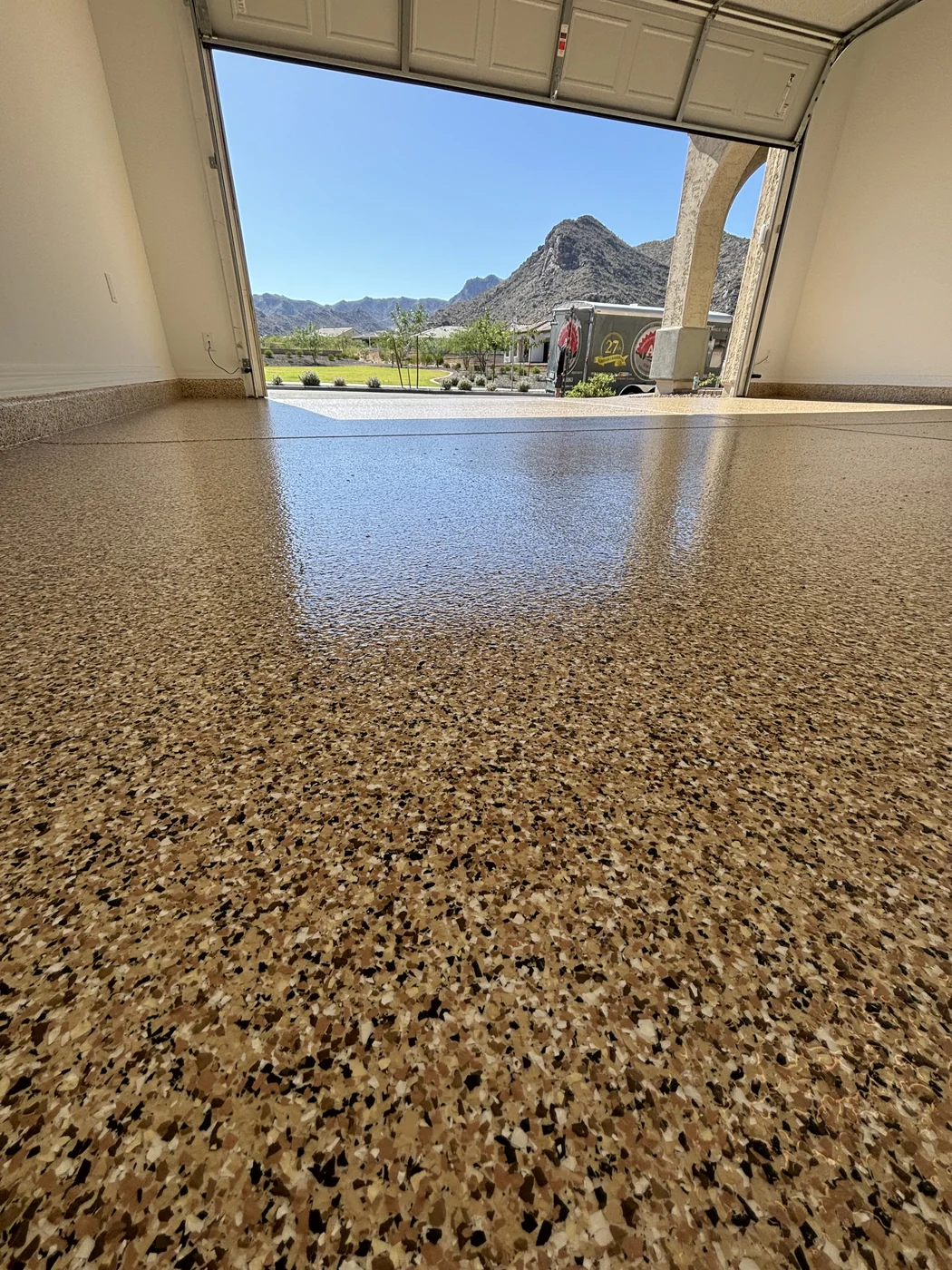
Polyaspartic is a newer, high-performance coating chemistry — a derivative of polyurea. It cures fast, stays flexible, and is 100% UV-stable, so it holds its color and clarity in direct sun instead of yellowing. It’s up to 4× more abrasion-resistant than standard epoxy and resists hot-tire pickup.
Because it cures so quickly, most polyaspartic garage floors are a one-day install — walk on it in hours, park the next day. The best systems actually pair a flexible polyurea basecoat with a UV-stable polyaspartic topcoat for the strength of one and the sun-resistance of the other.
6 Ways They Differ
The head-to-head that decides which coating is right for your Arizona garage.
So Which Should You Choose?
There’s no universally “right” answer — it depends on your space, budget, and how long you want the floor to last. Here’s the honest guidance:
- Choose epoxy if: you want the lowest upfront price, the space is indoors or gets little direct sun, and you’re comfortable with a shorter lifespan and a multi-day cure.
- Choose polyaspartic if: your garage sees Arizona sun and hot tires, you want it done in a day, and you want a floor that still looks new a decade from now without yellowing, cracking, or peeling.
For the typical Phoenix-metro garage — sun through the door, hot tires coming home off summer asphalt — polyaspartic (over a polyurea base) is the coating we recommend most often. But we’ll always give you a straight recommendation for your slab and budget, never a hard sell.
Can You Put Polyaspartic Over Epoxy?
Sometimes — if the existing epoxy is sound, well-bonded, and properly prepared (scuffed or ground for adhesion). More often, if an old epoxy floor is peeling, yellowed, or lifting, we diamond-grind back to bare concrete for the best possible bond. Either way, we’ll assess your current floor during a free on-site evaluation and tell you honestly what it needs.
Family-owned since 1995, licensed under Arizona ROC #168150, and rated 4.7★ across 89 Google reviews — we install both systems and give you the real trade-offs, in writing, before any work begins.
Polyaspartic vs. Epoxy FAQs
Explore More on Polyaspartic Coatings
Not Sure Which Coating Is Right for Your Garage?
Get a free, no-pressure on-site evaluation and an honest recommendation — epoxy or polyaspartic — with the price in writing. Family-owned since 1995 · ROC #168150.
or call (602) 254-3363
