Why Is Diamond Grinding Essential for Garage Coatings?
Why Diamond Grinding Is the Foundation of Every Lasting Garage Floor Coating
Key Takeaways:
- Diamond grinding opens the concrete surface profile at a microscopic level, creating the mechanical bond that allows epoxy to last for years rather than months.
- Skipping this step — or substituting acid washing or pressure washing — is the leading cause of premature epoxy delamination in Phoenix-area garages.
- Before signing any garage floor coating contract, ask your contractor exactly how they prepare the surface, what CSP they target, and how they manage dust and moisture vapor.
Epoxy doesn’t fail because the product is bad. It fails because the surface beneath it wasn’t properly prepared. Diamond grinding concrete before an epoxy application creates the microscopic profile that lets the coating bond mechanically to the slab — and without that bond, no amount of high-quality epoxy, decorative flake, or polyurethane topcoat will save you.
If you’ve had a floor coating peel, bubble, or delaminate, this is almost certainly the reason why.
What Diamond Grinding Actually Does to Concrete
Concrete slabs look both solid and porous, but their surface isn’t as open as it appears. During the curing process, concrete develops a layer called “laitance” — a weak, fine-grained skin of cement paste, dust, and curing compounds. This layer feels hard, but it’s structurally weak, and any coating applied on top of it bonds to that weak skin rather than to the dense aggregate below.
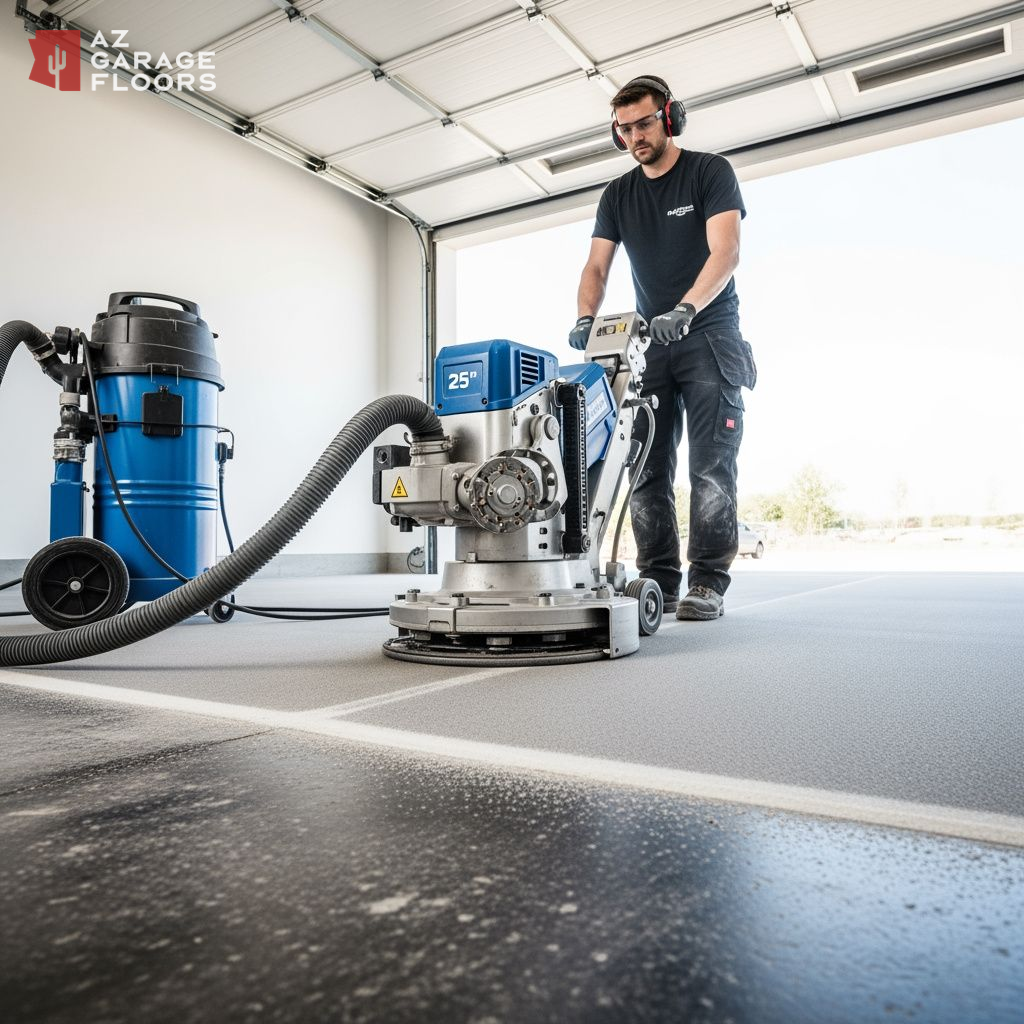
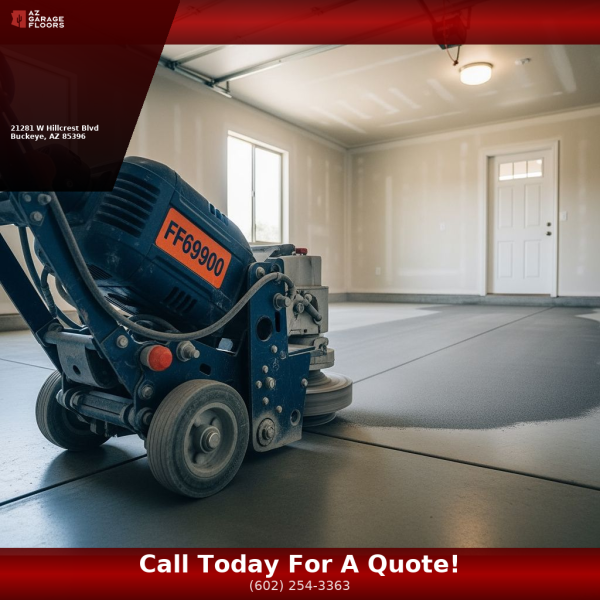
Diamond grinding removes laitance and opens what the industry calls the Concrete Surface Profile, or CSP. Rotating heads fitted with industrial-grade diamond segments abrade the surface, exposing the denser substrate and creating a texture that ranges from very fine (CSP 1-2) to more aggressive (CSP 3-4), depending on the system being installed. For a full multi-layer epoxy system with broadcast flake and a polyurethane topcoat, the International Concrete Repair Institute generally recommends a CSP of 3 or higher.
The result is a surface covered in micro-pores and mechanical “tooth.” When epoxy primer is applied to a properly ground floor, it flows into those pores and locks in place as it cures. The bond is structural, not superficial. That’s the difference between a coating that lasts a decade and one that starts peeling after the first Phoenix summer.
Why Acid Washing and Pressure Washing Aren’t Enough
Two alternative prep methods appear frequently in lower-bid proposals: acid washing and pressure washing. Both have legitimate uses, but neither opens the concrete profile the way diamond grinding does.
Acid washing (etching with muriatic or phosphoric acid) creates a shallow chemical reaction on the surface. It removes laitance and light contamination, but the resulting profile is uneven and shallow — typically CSP 1 to CSP 2 at best. For thin decorative coatings on new concrete, that may be marginally acceptable. For a thick epoxy system on an Arizona residential garage that endures 115°F summers, vehicle traffic, and daily temperature swings, it’s simply not sufficient.
Pressure washing cleans the surface. It removes dust, oils, and loose material. That’s valuable maintenance, but pressure washing creates no surface profile whatsoever. A floor washed and immediately coated will delaminate. Budget installers sometimes rely on acid or pressure washing because the equipment is inexpensive, the process is fast, and most homeowners don’t know how to ask about the difference between them. The savings show up on the invoice — and then again two years later, when the coating fails.
Where Most Failures Actually Begin
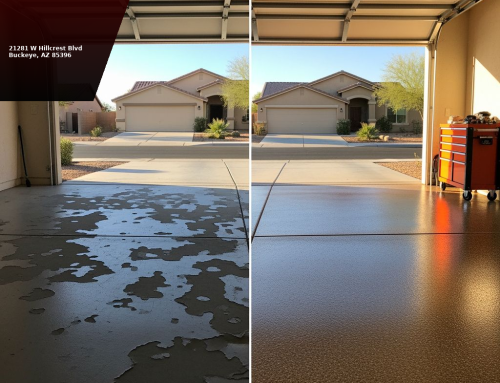
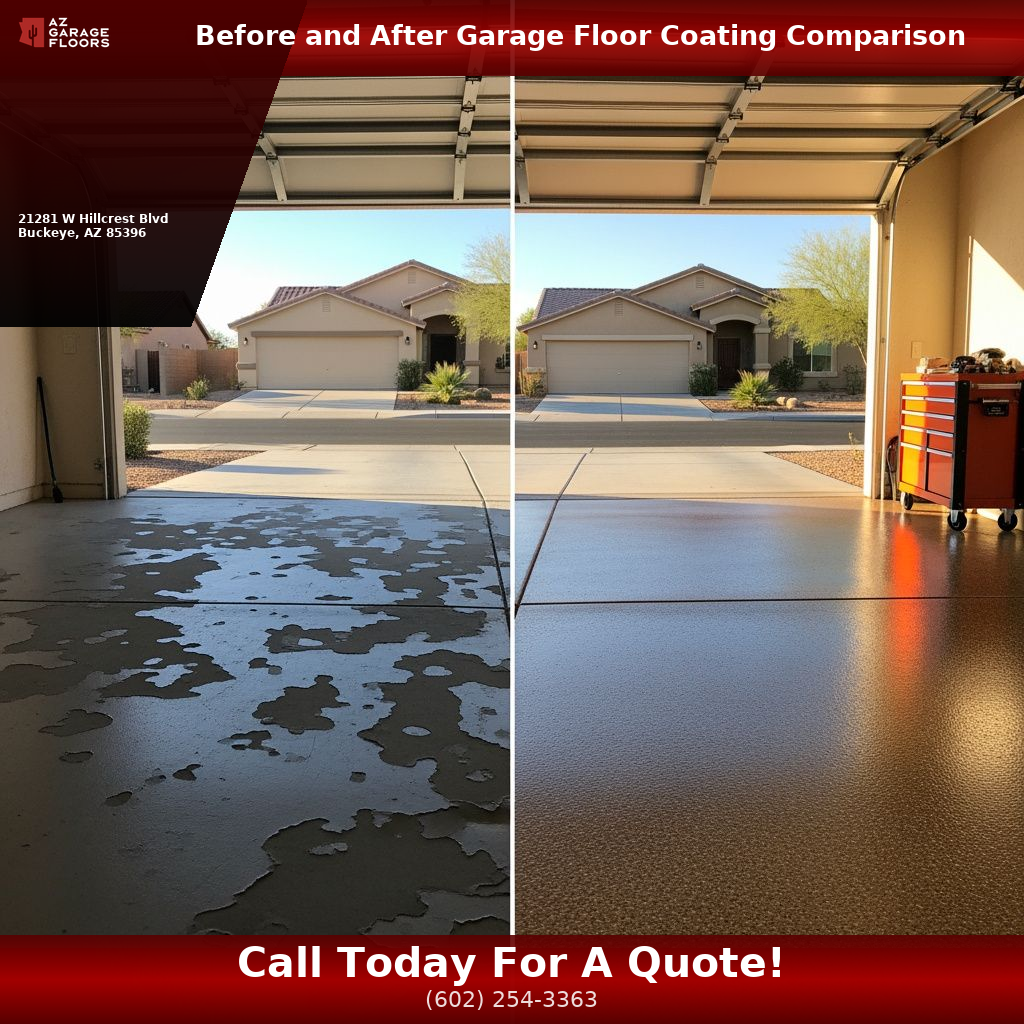
In 2026, the Phoenix metro is filled with homeowners who’ve already been through one failed epoxy installation. The pattern is remarkably consistent. A contractor offered a price significantly lower than competitors, the job was done quickly, the floor looked great for six to eighteen months, and then the coating started lifting at the edges, bubbling in vehicle tire paths, or peeling off in sheets.
Thermal cycling is particularly brutal here. Concrete expands in the Arizona heat and contracts overnight. A coating with a genuine mechanical bond flexes with the slab. A coating sitting on a poorly prepared surface simply breaks free. Moisture vapor adds another layer of stress — more on that below.
Skipping diamond grinding also shortens the process of identifying problem areas. A trained eye grinding a floor will immediately spot oil-contaminated zones, previous paint or sealer, cracks that need filling, and areas of high porosity that require different primer treatment. A contractor using a pressure washer walks past all of those issues.
How AZ Garage Floors Approaches Surface Preparation
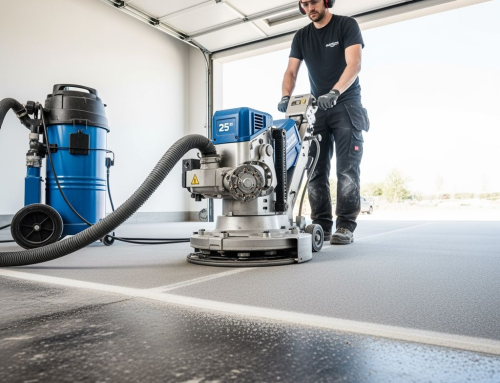
Every residential and commercial job AZ Garage Floors performs begins with industrial diamond grinding. The machines used are commercial-grade units, not the rental-grade equipment available at home improvement stores, which typically have underpowered motors and poorly fitted diamond heads that leave an inconsistent profile.
The grinding system includes a 99% dust-containment setup that captures concrete dust at the source. That means homeowners can stay in the house during the prep process. Children, pets, and interior furnishings are protected. There’s no cloud of silica-laden dust migrating through door gaps into the living space — a real health concern with uncontained grinding operations, given that OSHA identifies crystalline silica as a serious respiratory hazard.
After grinding is complete, the surface is inspected before any primer is applied to the floor. Oil spots that didn’t respond to the initial grind get additional treatment. Cracks are evaluated. CSP consistency is confirmed across the full surface. This quality assurance step adds time to the project, but it’s the step that separates installations that last from installations that become someone else’s repair job.
Questions to Ask Every Contractor Before You Sign
If you’re collecting quotes right now, the conversation about surface preparation reveals more about a contractor’s quality than any photo portfolio. Here are the specific questions worth asking, along with what the right answers look like.
- “Do you diamond grind every floor?” The answer should be yes, without conditions or exceptions for “newer” slabs or “clean” floors.
- “What CSP do you target for a full epoxy system?” A contractor who knows their trade should reference CSP 3 or higher for a thick broadcast system.
- “How do you handle dust containment?” If the answer doesn’t include a vacuum-attached collection system, expect a mess — and a health risk.
- “What if there’s an existing coating, paint, or sealer on the floor?” The correct answer is to remove it entirely with additional grinding passes, not to coat over it.
- “Can I see the floor before primer goes down?” A confident, professional contractor will say yes without hesitation.
Contractors who give vague answers, cite the concrete’s age as a reason to skip grinding, or pivot quickly to showing you color chip samples are often hiding a prep process that doesn’t hold up to scrutiny.
Surface preparation is a system, not a single step. Grinding opens the profile. Moisture assessment confirms the slab is ready to receive the coating. Quality inspection confirms the surface meets spec. Only then does the primer go down. Every shortcut in that sequence is a risk transferred from the contractor to your floor.
Moisture Vapor Assessment: The Step After Grinding
Even a perfectly ground floor can fail if moisture vapor moving up through the slab isn’t addressed before coating. Concrete is porous, and in many Arizona soil conditions, groundwater or irrigation moisture creates vapor pressure that pushes upward through the slab. Epoxy is relatively vapor-impermeable, so trapped vapor pressure can rupture the bond between coating and concrete — causing the same bubbling and delamination that under-profiling does.
After diamond grinding, AZ Garage Floors tests for moisture vapor transmission before applying primer. If vapor levels indicate a potential problem, the solution involves a vapor-mitigating primer formulated to tolerate higher moisture vapor emission rates. Skipping this test is a gamble that occasionally pays off and occasionally produces a floor failure that no amount of regrinding will fully correct.
Frequently Asked Questions About Diamond Grinding of Floor Coating
Sources
- Concrete Surface Profile (CSP) classification and recommendations for adhesive-applied systems — International Concrete Repair Institute (ICRI): https://www.icri.org
- Crystalline silica health hazards and OSHA exposure limits for construction operations — Occupational Safety and Health Administration: https://www.osha.gov/silica-crystalline
About AZ Garage Floors
AZ Garage Floors is a family-owned concrete coating company serving Buckeye, Surprise, Peoria, Avondale, and Phoenix. With decades of combined experience and hundreds of residential and commercial installations, AZ Garage Floors offers a full spectrum of garage floor coatings — from decorative residential systems (solid color epoxy, Granitex chip systems, metallic epoxy) to industrial commercial solutions (epoxy mortar, heavy-duty polyaspartic, chemical-resistant and anti-slip systems). The company utilizes commercial-grade 2-part resin products, thorough substrate preparation, and performance-based specifications to ensure longevity and safety. AZ Garage Floors offers residential warranty options and commercial warranty terms tailored to the project’s scale and usage.